
Rubidium-81 (Rb-81) is a radioactive isotope of rubidium with a short half-life of approximately 4.58 hours. It decays by electron capture and positron emission to krypton-81, largely through the metastable state krypton-81m (half-life 13 s, 190 keV gamma line). Rb-81 is not found naturally and is produced in cyclotrons by proton irradiation of krypton. Rubidium-82m (Rb-82m, half-life 6.47 hours) is co-produced in the same irradiation; it decays by electron capture (about 79%) and positron emission (about 21%) to stable krypton-82, emitting gamma lines at 554, 619 and 776 keV. Rb-82m should not be confused with Rb-82 (half-life 75 s), the isotope used for cardiac PET.

Rb-81 is used as the parent nuclide in Rb-81/Kr-81m generators. The short-lived Kr-81m gas (190 keV) is inhaled by the patient for lung ventilation imaging with gamma cameras; because Kr-81m decays within seconds, ventilation studies can be repeated or performed immediately after a perfusion scan. Rb-81 itself is not a PET agent. Rb-82m has been studied as a longer-lived substitute for Rb-82 in cardiac PET but is not in clinical use; in practice it is a radionuclidic by-product that remains on the generator column together with Rb-81.

Because of their artificial production and short half-lives, Rb-81 and Rb-82m are encountered only in controlled environments such as nuclear medicine departments and research laboratories. A gamma spectrum of an Rb-81/Kr-81m generator shows both nuclides: the 190 keV line of Kr-81m, the 446 and 511 keV lines of Rb-81, and the 554, 619 and 776 keV lines of Rb-82m. Their rapid decay makes accidental environmental presence highly unlikely.
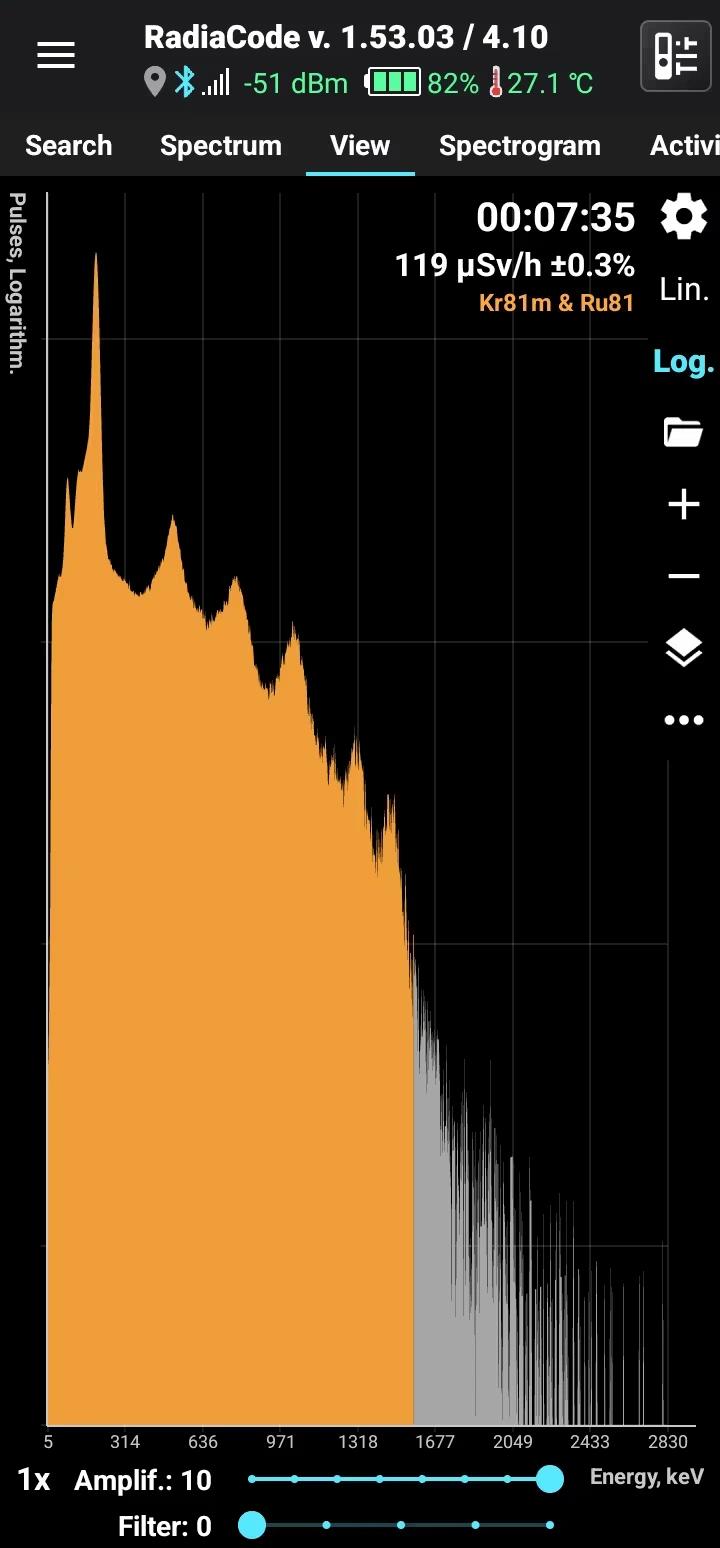
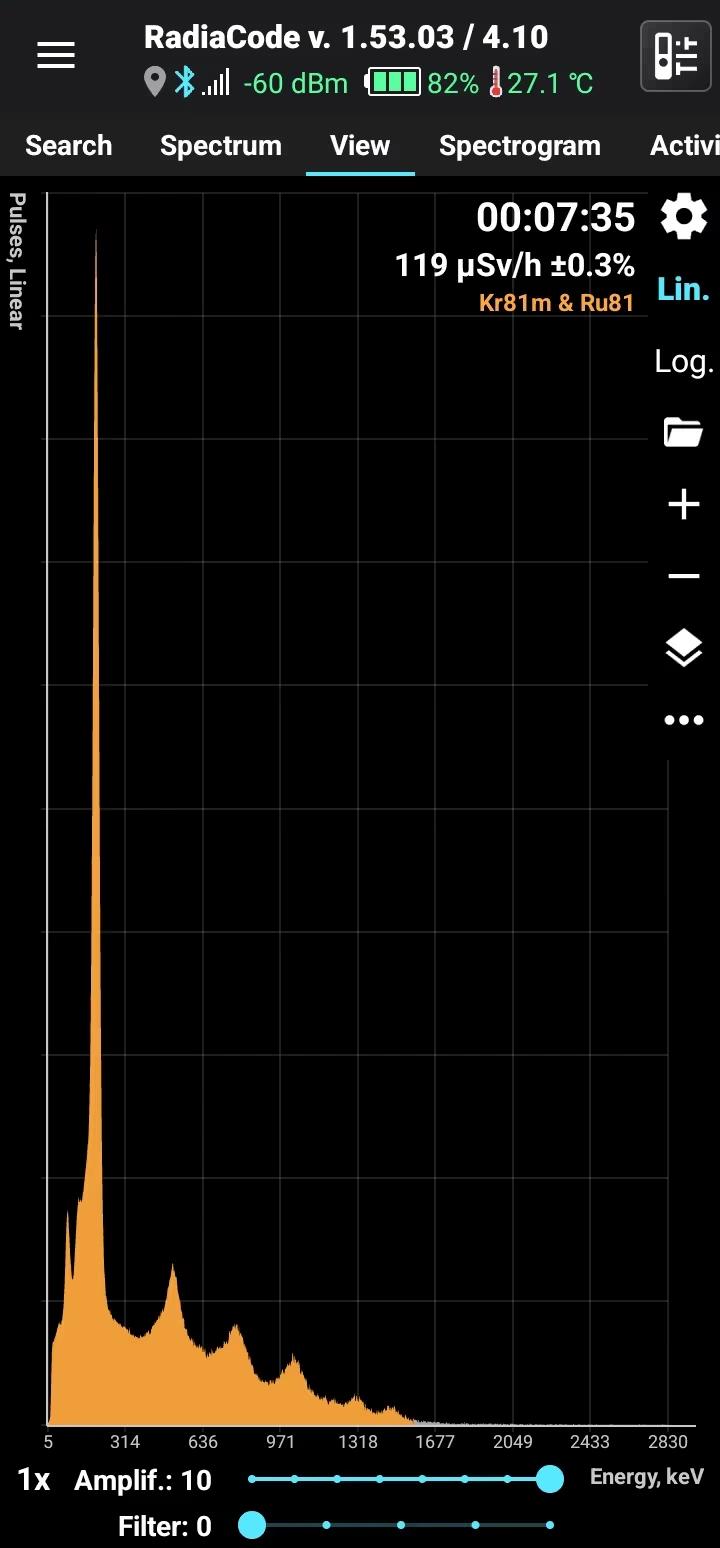
Rb-81 + Rb-82m
Rubidium-81 + Rubidium-82m
Rubidium-81 Half-life: 4.58 hours Main emission lines: 190, 446, 511 keV Decay chain: Kr-81, Br-81 Rubidium-82m Half-life: 6.47 hours Main emission lines: 554, 698, 1044, 1317, 1474 keV Decay chain: Kr-82
Rb-81. Decay mode ec Beta+
Beta+
| Avg. En., keV | Intensity, % | Decay En., keV |
| 448 | 25 | 2072 |
| 254 | 1.82 | 1597 |
| 227 | 0.28 | (1538) |
Gamma
| Energy., keV | Intensity, % |
| 190.46 | 64.9 |
| 446.15 | 23.5 |
| 510.4 | 5.4 |
| 456.73 | 3.06 |
| 537.60 | 2.26 |
| 1368.1 | 0.87 |
| 803.72 | 0.84 |
| 834.74 | 0.82 |
| 357.39 | 0.77 |
Annihilation
| Energy., keV | Intensity, % |
| 511.0 | 55 |
X-rays
| Energy., keV | Intensity, % |
| 12.649 | 32.8 |
| 12.596 | 17.0 |
| 14.105 - 14.313 | 8.65 |
| 14.105 - 14.233 | 7.86 |
| 1.386 - 1.911 | 2.47 |
| 14.312 - 14.313 | 0.79 |
Auger electrons
| Energy., keV | Intensity, % |
| 1.093 - 1.897 | (3) |
| 10.478 - 14.299 | (9) |
| 10.478 - 10.970 | (6) |
| 12.110 - 12.635 | (23) |
Rb-82. Decay mode ec Beta+
Beta+
| Avg. En., keV | Intensity, % | Decay En., keV |
| 353 | 19.7 | (1825) |
| 276 | 0.61 | (1645) |
| 722 | 0.4 | (2652) |
| 625 | 0.36 | (2379) |
Gamma
| Energy., keV | Intensity, % |
| 776.52 | 84.39 |
| 554.35 | 62.4 |
| 619.11 | 37.98 |
| 1044.08 | 32.07 |
| 698.37 | 26.3 |
| 1317.43 | 23.7 |
| 827.83 | 21.0 |
| 1474.88 | 15.5 |
| 1007.59 | 7.17 |
| 183.27 | 2.13 |
| 221.46 | 2.07 |
| 606.37 | 2.01 |
| 583.80 | 1.33 |
| 1081.29 | 1.31 |
| 455.28 | 1.27 |
| 1650.37 | 1.18 |
| 273.48 | 1.04 |
Annihilation
| Energy., keV | Intensity, % |
| 511.0 | 43 |
X-rays
| Energy., keV | Intensity, % |
| 12.649 | 25.7 |
| 12.596 | 13.3 |
| 14.105 - 14.313 | 6.79 |
| 14.105 - 14.233 | 6.16 |
| 1.386 - 1.911 | 1.91 |
| 14.312 - 14.313 | 0.62 |